Bug Removers for Cars: Choose and Use the Right Formula
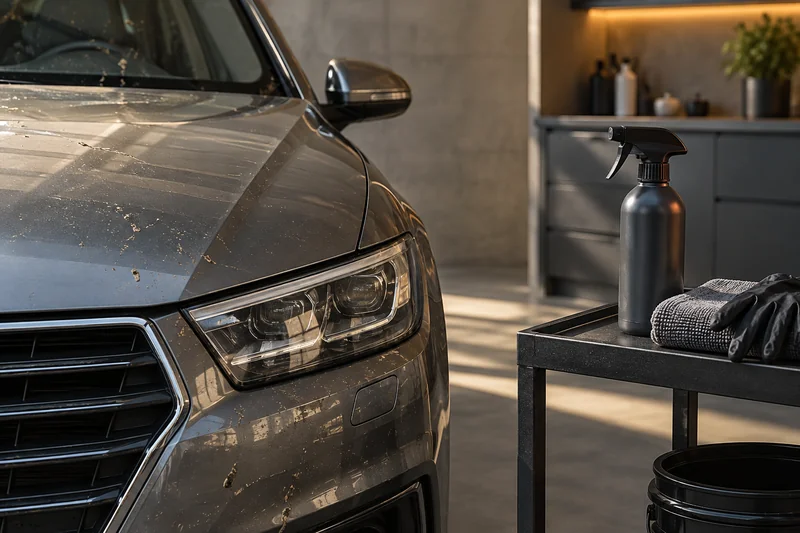
Start bug removal with the wash method your vehicle and finish allow. Rinse away loose grit, then use the approved car shampoo and contact tool. If insect residue remains, choose a bug treatment by its application instructions and surface limits. A ready-to-use spray, a concentrated wash additive and a container of wipes require different handling. If a film was recently installed, check its washing waiting period before starting.
The original product section below covers seven identifiable U.S. products and their manufacturer instructions. We have not performed a side-by-side cleaning, scratch or coating-durability test. The choices below describe each product’s application process without ranking cleaning power. Some shopping links are affiliate links, and we may earn a commission if you buy through them.
Match the job · Check your finish · Compare products · Plan the cleanup · Reader questions
Top 8 best car bug removers by use case
These products are ordered for the stated use cases. The list is documentary: it does not report measured performance or rank the whole market. Check the exact formula, surface and received directions before choosing.
How this shortlist is ordered
Order for this page: full-wash precleaning first, then local spot and portable wipe formats.
How we order these choices- GYEON Q²M Bug&GrimeBest for Pre-wash with a pressure washer
- SONAX Insect Remover, 05332000 / 533200, 500 mlBest for A bug pre-cleaner with a defined rinse-off dwell
- Adam’s Bug Remover, 16 ozBest for Pre-wash treatment on permitted bodywork
- Chemical Guys Bug Plus Tar Remover, CWS_104_16Best for Measured spray-bottle dilution
- Rain-X Pro 3-in-1, 620213Best for Ready-to-use spot cleanup with a one-minute dwell
- ExoForma Bug Remover, 16 ozBest for Wet-panel insect treatment before wiping
- Goo Gone Automotive Spray Gel, 2060Best for Residue removal followed by soap-and-water cleanup
- 3D Bug Remover Wipes, 103WBest for Individually accessible wipe cleanup

01Documented task fit
Best for Pre-wash with a pressure washer
GYEON Q²M Bug&Grime
GYEON specifies a brief dwell, a thorough pressure rinse and a regular wash afterward. Use this route when insect cleanup is part of the full wash.
Why this position: First when insect removal is part of a full wash with a pressure rinse. The explicitly linked pre-wash, rinse and wash steps define the main scenario here.
Check before choosing: Never let it dry. GYEON cautions that excessive use can affect a coating’s hydrophobic properties; “coating safe” does not approve every installed film or sensor.
02Documented task fit
Best for A bug pre-cleaner with a defined rinse-off dwell
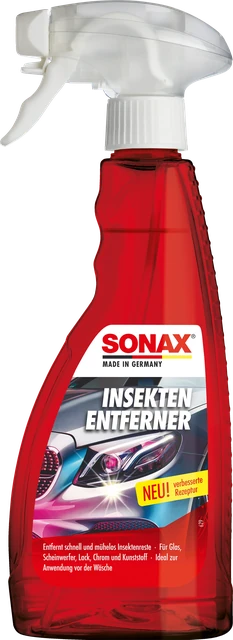
SONAX Insect Remover, 05332000 / 533200, 500 ml
SONAX specifies a 3–5-minute dwell on the treated area, followed by a thorough water rinse or a car wash. Use the identified single 500 ml bottle as a pre-wash cleaner.
Why this position: Second for another pre-wash route with a stated rinse-off dwell. It follows the pressure-rinse example as a separately timed wash-stage option.
Check before choosing: Keep it off hot surfaces and do not let it dry; SONAX excludes motorcycles. Paintwork permission does not establish compatibility with every wrap, film or existing coating. Check the received label and finish instructions.

03Documented task fit
Best for Pre-wash treatment on permitted bodywork
Adam’s Bug Remover, 16 oz
Adam’s directs a wash and rinse after this pre-wash treatment. Follow the received bottle for the dwell time; the current product page gives no timed interval.
Why this position: Third as a bodywork pre-wash with a required wash and rinse. The received bottle must supply dwell timing; its wrap and protection restrictions remain visible.
Check before choosing: Cool the panel and do not let the cleaner dry. Adam’s excludes vinyl wraps and warns that non-ceramic protection can weaken.
04Documented task fit
Best for Measured spray-bottle dilution
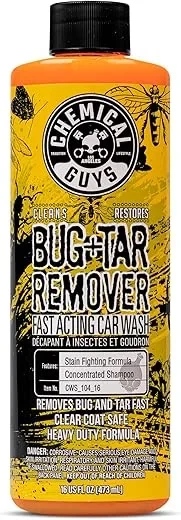
Chemical Guys Bug Plus Tar Remover, CWS_104_16
The spray route uses six parts water to one part concentrate, followed by wiping and a clean-water rinse.
Why this position: Fourth for a measured concentrate spray route. The mixing task and separate bucket recipe make this a more preparation-dependent alternative.
Check before choosing: Do not substitute that spray ratio for the bucket recipe. Avoid direct sun and confirm finish compatibility.
05Documented task fit
Best for Ready-to-use spot cleanup with a one-minute dwell
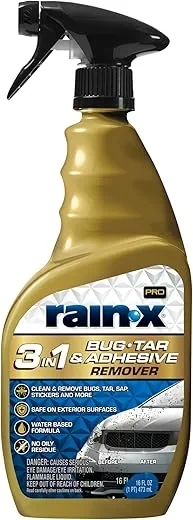
Rain-X Pro 3-in-1, 620213
The 16 oz version specifies a cool shaded surface, a one-minute dwell and wiping; washing can be needed to finish cleanup.
Why this position: Fifth for ready-to-use local cleanup with a one-minute initial dwell. It follows wash-stage routes because spot wiping and finishing cleanup are a different setup.
Check before choosing: The documented metal, glass and plastic scope does not override film or vehicle restrictions. Do not confuse the 16 oz product with a different regional bottle.

06Documented task fit
Best for Wet-panel insect treatment before wiping
ExoForma Bug Remover, 16 oz
ExoForma calls for wetting the surface first, then a two-minute dwell before wiping.
Why this position: Sixth as the separately identified wet-panel spot method. Wetting first and its own dwell cannot be exchanged with the preceding dry or shaded-surface recipes.
Check before choosing: Keep it off warm panels and never let it dry. Its coating claim depends on following the instructions.

07Documented task fit
Best for Residue removal followed by soap-and-water cleanup
Goo Gone Automotive Spray Gel, 2060
A pretested spot treatment and a clean white cloth suit localized residue; the manufacturer finishes with soap and water.
Why this position: Seventh for a pretested localized residue job followed by soap-and-water cleanup. Its broad material exclusions make it a narrower choice than a general insect pre-wash.
Check before choosing: Do not apply it to rubber, leather, suede or upholstery. Permission on clear coat does not automatically include PPF.
08Documented task fit
Best for Individually accessible wipe cleanup
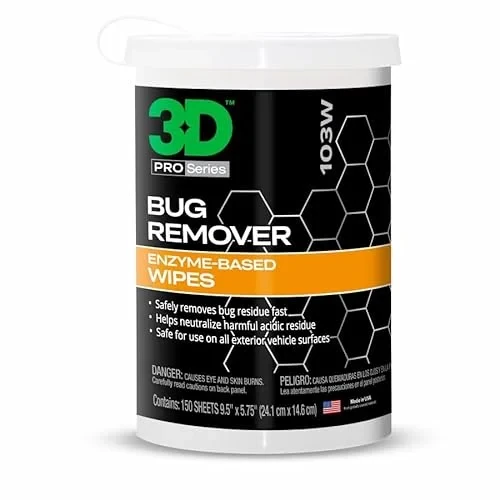
3D Bug Remover Wipes, 103W
The 50-wipe product is a separate format from 3D’s liquid cleaner. The wipe route includes removing excess cleaner afterward.
Why this position: Eighth for the portable wipe format. It answers access to an individual wipe, not a claim that wipes replace a complete wash or outperform liquids.
Check before choosing: Use the 103W instructions and handling precautions. Do not transfer dwell times or package assumptions from the liquid product.
Match the cleaner to the contamination and the job

Bird droppings are a different cleanup job from insect remains. Use our bird-dropping removal guide to check the outer surface, soften dried contamination, and decide when gentle cleaning should stop.
Bug splatter on a bumper is a different cleaning problem from adhesive left by a sticker, black tar deposits or contamination on a wheel. A product may cover more than one job, but its name does not establish permission for every surface.
| Your situation | Process to consider | What to check first |
|---|---|---|
| Fresh splatter during an ordinary wash | Your vehicle-approved shampoo and gentle contact method | Vehicle directions, grit removal and the permitted tool |
| Residue that remains after washing | A compatible bug spot treatment or pre-wash | Wet versus dry application, dwell time and removal method |
| You want removal integrated into a wash | A labeled wash concentrate or additive | The bucket dose; it is not the spray-bottle dilution |
| A roadside cleanup without a full wash | A product with a documented spot-cleaning route | Whether it requires additional cleaner, soap and water, or rinsing |
| Tar, adhesive or suspected iron contamination | A treatment labeled for that contaminant and finish | Identify the deposit before escalating chemistry or rubbing harder |
| Bugs on the windshield while driving | The vehicle-approved washer fluid in the reservoir | Reservoir compatibility and temperature rating; not body-panel use |
All-purpose cleaners and wheel cleaners are not automatic substitutes for a paint-approved bug remover. Keep tar removal and iron removal as separate decisions rather than adding stronger chemicals to an unidentified mark.
Check the finish before applying a bug remover
Identify what you will actually touch: exposed painted clear coat, paint protection film (PPF), a vinyl wrap, a ceramic coating, textured plastic, ordinary glass or a camera lens. A statement about clear coat does not establish suitability for all of these materials. Follow both the vehicle instructions and the instructions for any added film or coating; resolve a conflict before applying the cleaner.
- Vinyl wraps: Adam’s explicitly excludes satin, matte and gloss vinyl wraps. A hidden-area test does not override that exclusion.
- PPF and ceramic coatings: Require instructions for your particular film or coating. The 3D wipes page mentions PPF; ExoForma’s coating claim is conditional on correct use. Neither is a guarantee for every installed finish.
- Rubber and trim: Goo Gone Automotive’s back label excludes rubber. Muc-Off excludes prolonged contact with rubber. Keep these specific limits ahead of broad claims about exterior use.
- Glass, cameras and sensors: A formula permitted on ordinary glass is not automatically permitted on camera lenses, sensor faces or coated glass. Check their separate care instructions.
For example, the current U.S. Model 3 manual specifies mild car shampoo, cold or lukewarm water and a clean soft cloth for hand washing. It cautions against acidic cleaners and certain alkaline or caustic ingredients, and recommends high-quality microfiber rather than rough or tight-napped washing mitts. For cameras, it specifies water and microfiber and prohibits chemical or abrasive cleaners. It also prohibits sharp or abrasive objects on cameras and ultrasonic sensors. These are Model 3 instructions, not a claim that the products below are approved for every Tesla. Read the U.S. Model 3 cleaning manual.
Newly installed film can change even the first wash decision. The current 3M PPF FAQ, Revision B (August 2026), covers Pro Series 200 and Series 150 and 100. It says not to wash during the first 72 hours after installation and favors hand washing; if a car wash is necessary, it specifies touchless because brushes can dull or scratch the film and lift edges. It also excludes waxes with dyes, abrasive polishes and rubbing compounds. Its separate stain-removal advice is specific to those films, not a universal recipe for painted panels or vinyl wraps. Identify your film and ask the installer to resolve conflicting care directions before treating it.
Read the container’s handling precautions before use. Product descriptions such as water-based, enzyme-based or pH-neutral do not replace those precautions, surface exclusions or cleanup instructions. A safety data sheet describes hazards and handling; it does not grant permission to clean a particular wrap, coating or camera.
Seven products with different application routes
Check the seller’s current package and the label you receive against the exact size and code below. Check the supplied accessories and directions on the current package. An older photo or brand name alone does not establish them or current availability.
Adam’s Bug Remover: pre-wash with a separate touch-up route

The current U.S. 16 oz variant is BUG347-01-016, UPC 810004212275. Adam’s describes a water-based, high-sudsing formula. Its washing label directs you to shake the bottle, work on a cool surface, rinse first, spray the bug residue and allow 30 seconds to one minute before proceeding with foam and the wash process. Thoroughly rinse the cleaner and residue away afterward. Use a contact tool your vehicle permits.
The touch-up route is different: apply to a towel, gently remove the bugs, then use Adam’s Detail Spray or Waterless Wash to remove excess bug cleaner. Do not assume the pre-wash spray is a complete wipe-and-leave treatment. Never let it dry; avoid sun where possible. It is not for satin, matte or gloss vinyl wraps. Adam’s also acknowledges degradation of existing non-ceramic protection, so do not call it universally wax-safe. Manufacturer directions and label images.
Check the Adam’s 16 oz package on Amazon
Chemical Guys CWS_104_16: wash concentrate or diluted spray

The current 16 oz variant is CWS_104_16, UPC 816276011486. The product page gives three routes: add 2 oz to a wash bucket for the two-bucket method; add 2 oz to a bucket containing another wash soap; or dilute in a spray bottle at six parts water to one part cleaner. The spray route calls for microfiber wiping followed by a clean-water rinse. The wash routes also end with rinsing.
The current product page does not specify a bucket water volume, so its 2 oz instruction is not a complete ounces-per-gallon recipe. Use the applicable bottle directions rather than converting the earlier capful-per-gallon claim into a new dilution. Avoid leaving active product in direct sunlight. Do not transfer the spray dilution to the wash bucket or assume a foam cannon dose. Product instructions and the manufacturer’s explanation of the 6:1 ratio.
Check Chemical Guys CWS_104_16 on Amazon
Rain-X Pro 3-in-1: a defined spot-cleaning process

Choose U.S. 620213, 16 oz; the manufacturer separately lists a 23 oz version, 620213SRP, and a Canadian item. This water-based product is positioned for spot cleaning or use before a wash. Work on cool surfaces outside direct sunlight, spray the contamination, allow one minute, then gently wipe with a clean microfiber towel. The directions allow longer soaking for thick or baked-on debris without specifying a maximum time; do not invent one.
Rain-X says to wash the vehicle as needed after this process. That is different from Chemical Guys’ required clean-water rinse, and it does not establish a no-rinse rule for other products. The stated exterior metal, glass and plastic scope is not specific approval for your wrap, PPF, coating or camera. Rain-X U.S. item table and directions.
Check Rain-X U.S. 620213 on Amazon
3D Bug Remover Wipes: distinguish spot wiping from pre-washing

The manufacturer’s 103W wipes container has UPC 606663055540 and 150 sheets. For spot cleaning, the page directs you to clean the exterior with a wipe and wipe away excess solution. For pre-washing, it specifies 30–45 seconds of dwell, or 2–3 minutes in cooler weather, followed by a clean-water rinse. Do not borrow dilution or spraying instructions from the liquid Bug Remover merely because both products share a brand.
3D describes an enzyme-based formula and lists paint, PPF, glass, plastic and rubber. Check the installed finish’s directions too. The front label carries an eye and skin burn warning and tells you to read the back precautions; broad surface claims are not a handling guarantee. 3D’s wipes-specific directions and package images.
Check the 3D 103W 150-sheet package on Amazon
ExoForma Bug Remover: wet the surface first

The current single 16 oz variant is identified as BugRemov16oz + Sprayer. ExoForma describes an enzyme-based formula for paint, glass, chrome and plastic. Its application FAQ is specific: wet the surface first, spray liberally over the affected areas, allow two minutes, then wipe away. Do not use it on warm, dry surfaces.
The manufacturer says correct use will not affect coatings. Treat that as its conditional claim, not our independently measured coating-durability result or universal film approval. Do not copy Muc-Off’s wash-and-dry preparation for ExoForma; it changes the required wet-first process. ExoForma’s current application FAQ.
Check the ExoForma single 16 oz package on Amazon
Muc-Off 20985: clean and dry before spot treatment

Match 20985, 250 ml/8.4 fl oz, EAN 5037835217315. The U.S. product page says to wash and dry the surface first, keeping it cool and outside direct sunlight. Shake, spray, allow 1–2 minutes and wipe with a clean, dry microfiber cloth. For stubborn contamination it permits up to five minutes, never longer. Protection is a separate follow-up step.
Its hard-surface scope includes paint, metal, chrome, hard plastics and glass. The manufacturer recommends testing a small, inconspicuous area first. It excludes prolonged rubber contact and helmets or helmet visors. There is a cleanup discrepancy: the U.S. product page describes wiping, while a related U.S. how-to adds rinsing. Check the directions on your supplied 20985 bottle and resolve a mismatch with Muc-Off before use. U.S. product directions and the related how-to.
Check Muc-Off 20985, 250 ml, on Amazon
Goo Gone Automotive: adhesive cleanup with label exclusions

The 2060, 12 fl oz Automotive Spray Gel has UPC 070048026973. It is useful to consider for adhesive and asphalt cleanup on permitted hard surfaces, rather than treating every Goo Gone product as the same bug-removal formula. Its label calls for an inconspicuous-area pretest, application to the mess, a few minutes of working time, wiping with a clean white cloth and washing the area with soap and water.
The back label excludes rubber, leather, suede and upholstery. Some website FAQs give broader fabric or Plasti Dip advice; the exclusions take precedence here. Automotive clear-coat permission does not establish wrap or PPF approval. Automotive Spray Gel directions and back label.
Check Goo Gone Automotive 2060 on Amazon
Plan the cleanup before the product is on the car
Work out how you will remove the cleaner before you apply it. If a process requires soap and water, a full wash or another residue-removal product, a dry towel alone cannot complete a roadside cleanup.
- Prepare the permitted surface. Check the finish, vehicle instructions and label. Work within the product’s temperature and sunlight limits. Rinse loose grit before contact where the vehicle’s wash procedure calls for it.
- Use that product’s preparation. ExoForma requires a wet surface; Muc-Off requires washing and drying first. Neither preparation is a rule for the entire category.
- Measure only a documented dilution. Chemical Guys has a diluted-spray route. The ready-to-use products and wipes above do not inherit its 6:1 ratio.
- Apply, wait and remove as directed. Keep the required rinse or wash available. Where the label prohibits drying, do not leave a panel unattended while treating the rest of the car.
- Assess the cleaned surface before another treatment. Do not choose a stronger bug cleaner solely because an outline remains. If residue is gone but a mark remains, stop aggressive rubbing and have the finish assessed rather than diagnosing etching from appearance alone.
Choose the contact tool separately from the chemical. A mesh bug sponge, scrubber or wheel brush cannot promise scratch-free paint cleaning because it is advertised as soft. Follow the vehicle and tool instructions, keep grit out of the contact material and use clean cloth faces as they become contaminated. See the car wash brush guide for the distinction between permitted body-wash tools and wheel tools.
Why some earlier choices need a separate decision
Meguiar’s G180515 is still identifiable as a 15 oz Bug and Tar Remover, but its current product page is not a complete application label. Follow the can rather than an invented dwell or rinse recipe. The older Armor All 18498, Detail King 32 oz and Turtle Wax two-bottle bundle also need their exact supplied-package directions before they can be treated as equivalent choices. A current single bottle or differently coded quart does not verify an older seller bundle.
Carfidant’s ceramic-infused remover is a distinct product concept; its marketing does not establish a tested replacement for your existing coating or an additive dose. The previous BLACKLINE wheel cleaner, Rain-X and UltraVision reservoir fluids, and defogging or mesh sponges have different jobs. We do not use those listings to extend this guide’s paint, film or coating permissions.
Reader questions
Does Meguiar’s Heavy Duty Bug Remover protect the paint?
It is a cleaner, and removing contamination is different from depositing a new protective coating. Meguiar’s current G180515 description explains foam cleaning before or between washes; it does not establish a new wax or ceramic layer. Do not turn the earlier “paint protection” recommendation or a reader’s positive experience into that claim. Use any separate protectant according to the finish and protectant instructions.
Is Goo Gone Automotive suitable for stickers on car paint?
The Automotive Spray Gel label supports automotive clear coat and sticker cleanup with its pretest and soap-and-water finish. Use the Automotive product and the hard-surface process above; other Goo Gone products are not interchangeable. Keep it off excluded rubber, and get specific permission before using it on a wrap or PPF.
How soon should I clean bug splatter?
Do not use a fixed “every few weeks” interval to decide how long residue should remain. Check your vehicle’s care instructions and remove contamination promptly using the allowed process. The Model 3 manual specifically says not to wait for the next complete wash. Heat, finish and contamination vary; we have not established a universal number of hours before damage occurs.
Can I use vinegar, dish soap or a stronger all-purpose cleaner instead?
Do not assume that a household recipe or a stronger dilution is permitted on your paint, film, coating or trim. Start with the vehicle-approved wash method. For residue that remains, use a documented treatment for that finish and contaminant. This guide does not supply an unverified universal vinegar mixture or a substitute degreaser recipe.
Can I use the same product on the windshield and cameras?
Check ordinary-glass permission and any glass coating instructions, then handle cameras and sensors separately. The Model 3 camera restriction above excludes chemical and abrasive cleaners even when a product is marketed for glass. For the washer reservoir, use only the fluid the vehicle permits, with the appropriate climate rating. Rain-X 68806 and UltraVision +32°F are warm-weather washer fluids, not body-panel bug treatments; their water-beading claims do not override an OEM restriction on windshield treatments.