How to Clay Bar a Car Without Skipping the Prep
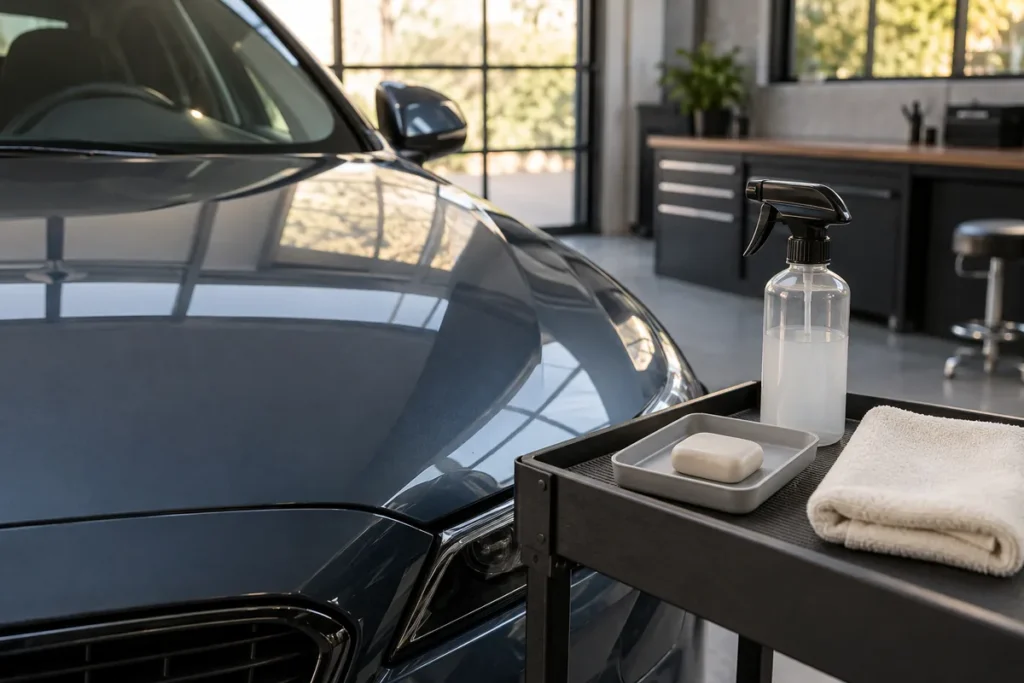
Clay a car when a suitable wash leaves a specific surface-contamination problem on suitable gloss paint. Match the clay or tool to its lubricant, work lightly in small sections, and inspect the result before choosing any further treatment. A smoother panel does not establish that a scratch, stain, or damaged finish has been repaired.
Mothers’ written guide supplies the conventional-clay example and the separate Speed Clay 2.0 route. Neither is a substitute for the directions supplied with a different product.
Top 5 best car clay and synthetic decontamination tools by use case
These products are ordered for the stated use cases. The list is documentary: it does not report measured performance or rank the whole market. Check the exact formula, surface and received directions before choosing.
How this shortlist is ordered
Order for this page: a defined clay-and-lubricant kit before separately supplied synthetic-tool setups.
How we order these choices- Meguiar's Smooth Surface Clay Kit G191700Best for conventional clay preparation when the included clay, detailer and towel fill a real gap
- Mothers Speed Clay 2.0 17240Best for a synthetic surface-preparation tool used with its own supported workflow
- Griot's Garage Brilliant Finish Synthetic Clay 10691Best for a hand-held synthetic-clay tool with a defined lubricant choice
- The Rag Company Ultra Clay Scrubber, 4 × 6 in, 2-packBest for a scrubber-format decontamination tool with a separate lubricant plan
- NANOSKIN AUTOSCRUB Sponge, Fine GradeBest for a fine-grade polymer sponge when its lubricant and break-in steps fit the setup

01Documented task fit
Best for conventional clay preparation when the included clay, detailer and towel fill a real gap
Meguiar's Smooth Surface Clay Kit G191700
Smooth Surface Clay Kit G191700 supplies conventional clay, detailer and a wipe-down towel for paint preparation when those are the missing supplies. It does not include a full washing setup or establish that clay can correct a visible paint defect.
Why this position: First when the shopping gap includes conventional clay, detailer and a wipe-down towel. That verified inventory answers a specific preparation need, not a scratch-correction task.
Check before choosing: The kit is not a full washing setup or scratch-correction system; match G191700 and the received contents.

02Documented task fit
Best for a synthetic surface-preparation tool used with its own supported workflow
Mothers Speed Clay 2.0 17240
Speed Clay 2.0 is a rubber-polymer preparation tool with two supported workflows: washing-stage use or clean, dry-panel use. Match one method to the finish and supplies. Washability does not establish faster or scratch-free work, or safe reuse after any drop.
Why this position: Second as the separately identified synthetic tool with two distinct supported workflows. The wash-stage and clean/dry-panel alternatives must be selected rather than blended.
Check before choosing: Its wash-stage and clean/dry-panel routes remain separate; reuse or washability does not establish scratch-free treatment or safe reuse after any drop.
More product photos


03Documented task fit
Best for a hand-held synthetic-clay tool with a defined lubricant choice
Griot's Garage Brilliant Finish Synthetic Clay 10691
Griot's identifies 10691 as a foam-grip synthetic-clay tool. The product page names Speed Shine or car-wash water as lubrication choices, providing a distinct format from a conventional clay kit that includes detailer and a towel.
Why this position: Third for a foam-grip synthetic tool with explicitly named lubricant choices. The defined contact format and permitted lubrication are the reasons to compare it.
Check before choosing: Match the surface, lubricant and complete tool directions. A maker's reuse or speed claim is not a scratch-free guarantee or a result tested by Hot Car Care; do not transfer this tool's drop-recovery advice to conventional clay.

04Documented task fit
Best for a scrubber-format decontamination tool with a separate lubricant plan
The Rag Company Ultra Clay Scrubber, 4 × 6 in, 2-pack
The Rag Company lists the Ultra Clay Scrubber as a 4-by-6-inch product supplied in a two-pack. Its description gives clay-lubricant decontamination and a wash-bucket maintenance role, offering a different contact format from a small clay bar.
Why this position: Fourth for the larger scrubber format with its own lubricant plan. A two-pack is one product choice, not two positions or proof of faster decontamination.
Check before choosing: The two-pack counts as one product choice. Match the finish, lubricant and received directions; marketing speed and effort claims do not establish a scratch-free method or justify scrubbing an unidentified coating.

05Documented task fit
Best for a fine-grade polymer sponge when its lubricant and break-in steps fit the setup
NANOSKIN AUTOSCRUB Sponge, Fine Grade
NANOSKIN identifies this item as the hand-used Fine Grade AUTOSCRUB Sponge. Its instructions make sufficient lubrication, initial break-in and prior removal of tar and grease explicit purchasing and preparation requirements.
Why this position: Fifth when the fine-grade sponge's break-in and lubrication conditions can be met. Its plain-water and solvent restrictions add preparation checks beyond a generic synthetic-clay label.
Check before choosing: Plain water is not an adequate lubricant under these directions, and the polymer is not solvent resistant. Do not borrow another synthetic tool's wash-water permission or treat the manufacturer's reuse count as a measured service life here.
Do You Need Clay After Washing?

Start with the remaining problem, rather than adding clay to every wash. If the finish is clean and there is no specific preparation need, there is no reason to complete a clay step just to finish a checklist.
Roughness after washing can prompt closer inspection; it does not identify the contamination by itself. Decide whether the task is removing material attached to the surface or investigating a visible defect. Color alone does not settle that distinction either.
| After the wash | Decision to make | Next action |
|---|---|---|
| No specific contamination remains | Is further preparation actually needed? | Continue the chosen care routine without an automatic clay step |
| A surface-contamination problem remains | Are the finish, tool, and lubricant suitable? | Use the matching documented process after those checks |
| A visible mark remains | Has contamination been distinguished from a different defect? | Reassess before repeating claying or choosing correction |
| Finish type or damage is unresolved | Is the process approved for this surface? | Stop the general procedure and obtain the applicable instructions |
This guide covers confirmed suitable gloss paint. Matte or satin finishes, paint-protection film, ceramic coatings, unknown treatments, and failing clearcoat need their own applicable care instructions. An unqualified “paint safe” claim does not resolve those cases.
Choose the Tool and Lubricant Together
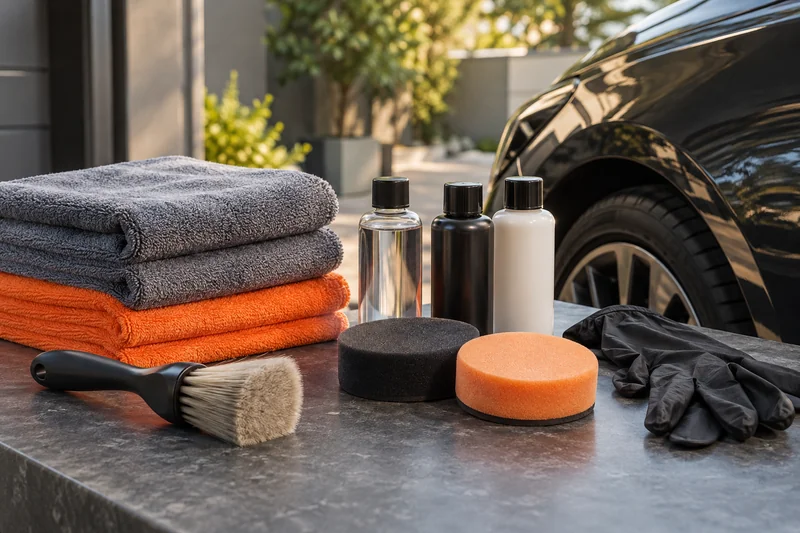
Choose one documented system. A conventional bar that uses detail spray and a polymer tool that has a wash-stage route are not interchangeable recipes.
| Tool | Working surface | Lubrication decision | Handling decision |
|---|---|---|---|
| Mothers conventional clay example | Pliable clay, refreshed by kneading | Use the specified detail-spray route | Expose clean clay; discard a dropped piece |
| Mothers Speed Clay 2.0 | Flat rubber-polymer tool | Choose its documented wash-stage or clean/dry-panel route | Inspect and clean the working face under its directions |
| Another bar, mitt, towel, or pad | Product dependent | Obtain that tool’s approved lubricant | Follow that tool’s condition and replacement checks |
Do not replace the lubricant with plain water, dish soap, or a chemical remover by analogy. An iron remover’s contamination-removal role does not establish that it is a clay lubricant. Keep chemical treatments separate unless the exact products explicitly authorize the combination. If the remaining task is unclear, compare iron removal with claying before stacking products.
Have the washing supplies and clean wipe-down towels ready before starting. A clay product alone does not cover those other jobs.
For a conventional bundle, check the G191700 kit components against supplies you already own. For the polymer format, review the two Speed Clay 2.0 methods before choosing a workflow.
How to Use a Traditional Clay Bar
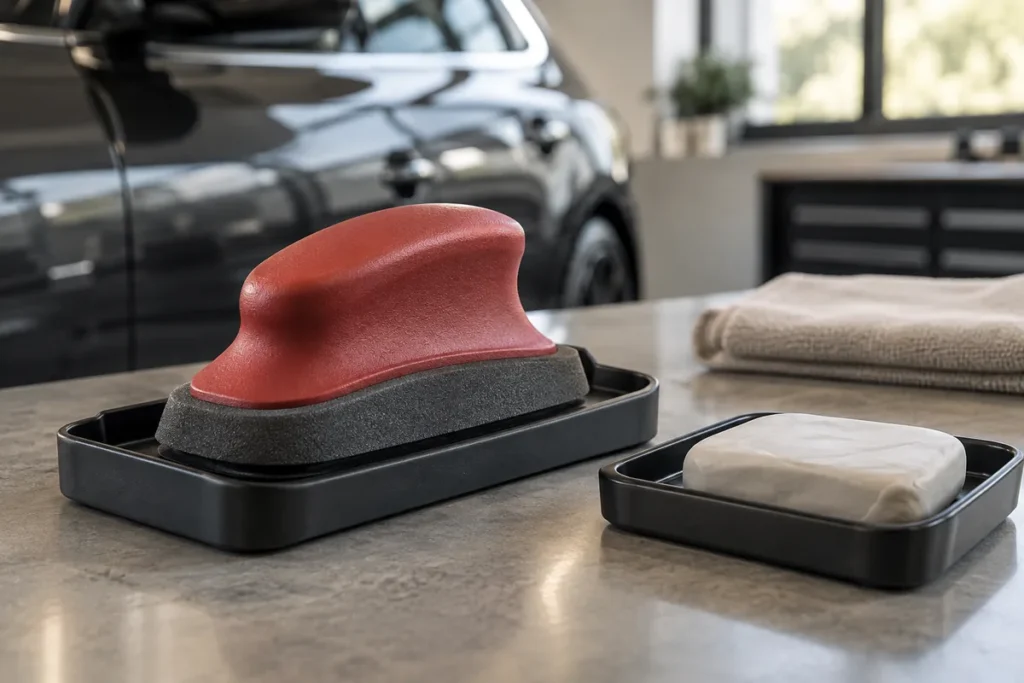
For the Mothers conventional-clay example, begin with washed paint and detail-spray lubrication. The working face and its ability to glide matter more than completing a set number of passes.
- Wash away loose dirt before claying.
- Shape a piece of clay into a manageable pad.
- Wet one small area with the specified detail spray.
- Slide the clay lightly while maintaining lubrication.
- Stop when it glides smoothly; wipe off the detailer.
- Inspect and knead the clay to expose a clean working face before continuing.
- Discard a piece that falls on the ground.
If the bar drags or skips, pause. Do not respond by pushing harder or repeatedly working a dry patch. Restore the documented lubrication and inspect the working face. If the problem remains unresolved, stop that section.
These are Mothers’ conventional-clay steps. A Meguiar’s kit needs its own matched instructions; its supplied detailer is not permission to transfer every other brand’s method.
What Changes With Speed Clay 2.0?

Speed Clay 2.0 has two separate documented routes. In the wash-stage route, wash and rinse the section before re-soaping and using the tool. In the clean/dry-panel route, use the specified detailer or spray-wax lubrication. Keep those starting conditions separate.
The tool’s washable working surface also changes the handling decision. Do not knead it like loose clay. Conversely, do not assume that rinsing any dropped polymer tool makes it suitable to return to paint. Dirt removal, working-face damage, and the actual instructions still need checking.
What to Check After Claying
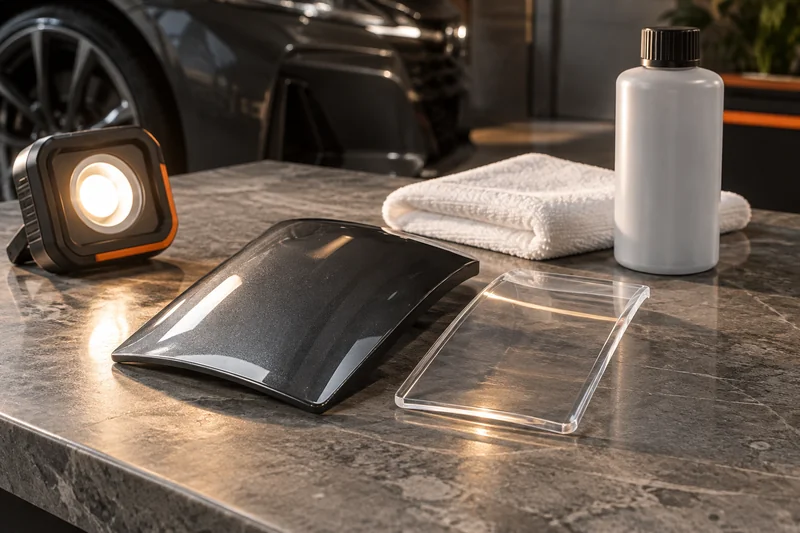
Check smoothness and appearance separately. A smooth section with a visible mark still has an unresolved appearance problem; continuing the same mechanical cleaning step is not evidence that the mark will disappear.
Inspect the treated area before committing to the rest of the car. If a new haze or mark appears, stop and reassess the surface and method. This guide does not diagnose the defect or prescribe sanding, a stronger compound, or clearcoat repair.
Polishing is a separate decision, rather than an automatic requirement for every vehicle. Where a specific remaining defect justifies correction, establish its nature and the finish’s suitability first. The Ultimate Compound review addresses that separate correction decision; its product claims do not identify your defect. For aftercare, plan protection under the chosen product system’s directions instead of assuming the previous wax remains intact. Mothers’ guide specifically warns that its clay process removes wax.
Questions Before You Start
Can I clay every time I wash?
Do not make it a fixed part of every wash. Use the remaining contamination and the applicable instructions to decide whether another preparation step is needed.
Can I use plain water as lubricant?
The Mothers conventional-clay example calls for detail spray. The Speed Clay wash route does not make plain water an approved substitute for that conventional process.
Must I buy a clay kit to follow this guide?
No. Suitable supplies you already own may cover the task. Buy only after confirming the tool, lubricant, finish, and missing items; a different tool still needs a matching procedure.
After the job, care for your paint-preparation towels according to their previous use and their own permitted wash and drying settings. Towel care does not change the clay instructions.
Sources and Scope
This is documentary guidance, checked against written instructions on October 13, 2026. No physical claying test or scratch-removal trial is claimed.
Mothers: conventional clay and Speed Clay 2.0 instructions
Mothers: Speed Clay 2.0 product 17240
Best Fit by Intent: Optional Product Searches
Use a search only if the selected task calls for these supplies. Suitable supplies already owned may be enough; the search is not a required purchase.